
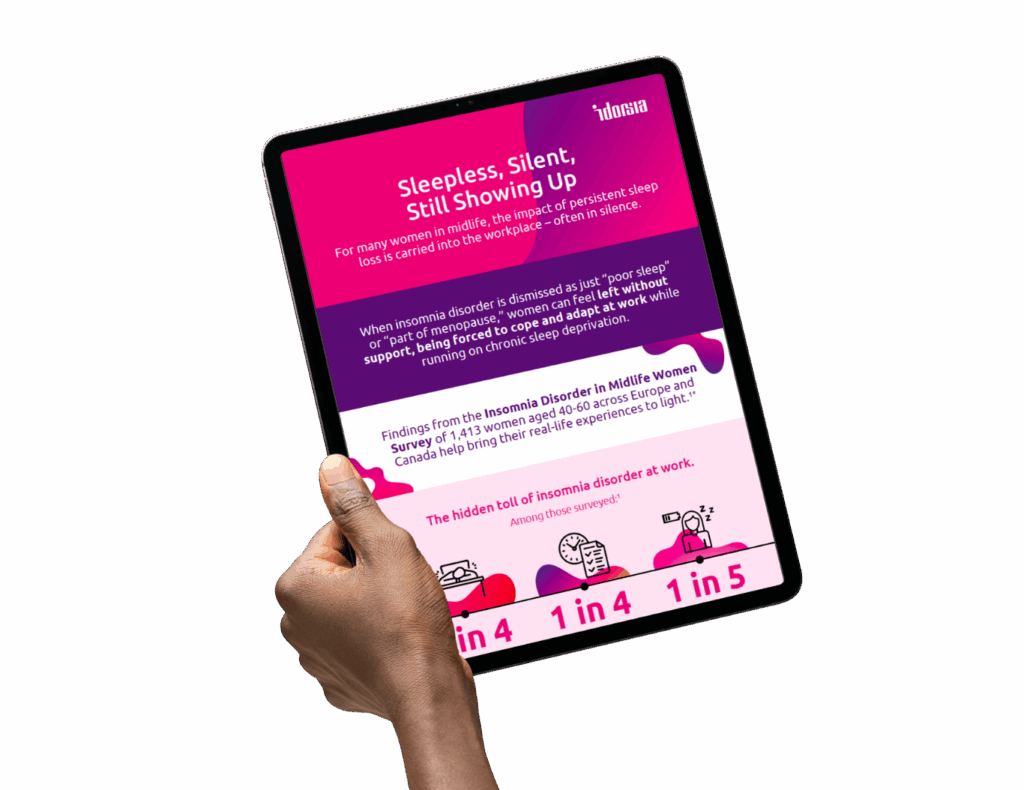
Sleepless, Silent, Still Showing Up
Key points :
- 75% say insomnia disorder has an impact on their performance and/or concentration at work.1
- 55% worry about the potential consequences of their sleeping problems on their job or career.1
- 63% feel confident in their ability to manage the impact of their insomnia disorder on their work.1
*On behalf of Idorsia, Ipsos conducted a 10-minute self-completion online survey among 1,413 women across 9 countries (UK n=189, France n=194, Spain n=180, Italy n=192, Germany n=187, Canada n=181, Sweden n=96, Austria n=98, Switzerland n=96) between 11th and 26th September 2025. The sample was comprised of women aged between 40 and 60 years old, stating that their sex at birth was female. These women stated that they led active lives, either being in employment, active in the community, caring for family members or managing the home, a student / in full-time education or have other caring responsibilities such as for children or other family members. Respondents consented to answering questions about their health and those who have been experiencing or have been diagnosed with the following conditions were excluded: bipolar disorder, schizophrenia, PTSD, narcolepsy, chronic pain. All respondents met the DSM-V criteria of insomnia disorder of experiencing sleeping difficulties for 3-7 nights a week for at least 3 months. Furthermore, severity of insomnia was assessed using a battery of statements and those whose scores put them in category 3 (moderate/severe insomnia) or 4 (severe insomnia) and those who said that insomnia had a somewhat to significant impact on their daily functioning were allowed to continue.
References
- Sleepless, Silent, Still Showing Up Infographic, Idorsia Ltd.
EUC-IDO-00077 | March 2026